


A moody living room sounds like a luxury only big houses can afford, but it works brilliantly in small UK homes. In a Victorian terrace or a 1930s semi, the living room is often just 10 to 15 square metres with one window and a chimney breast taking up a wall. Pale walls in a room like that can look washed out by 4 pm in November. Deep colour does the opposite: it makes the walls recede, the corners disappear and the room feel like a proper evening room instead of a box you happen to sit in.
The trick is restraint. Moody is one or two dark surfaces, warm light and plenty of texture — not a black cave. Here is how to do it in a small room, with real costs and without repainting the whole house.
1. Paint one wall dark, not four
Start with a single feature wall, ideally the chimney breast wall or the wall behind the sofa. A deep forest green, inky navy or charcoal reads as expensive; a whole room in the same shade can feel heavy in a north-facing terrace.
A 2.5-litre tin of good matt emulsion costs £26 to £45 and covers around 13 square metres — enough for one wall with two coats, with paint left over for touch-ups. Paint the wall, live with it for a week, and only then decide whether to take the colour further. In a rented flat, do the same thing with a dark removable wallpaper panel or a tall dark bookcase against the wall instead of paint.
2. Try colour drenching on the ceiling
A dark ceiling sounds wrong in a small room, and in a low room it is. But in the many UK living rooms with 2.4-metre ceilings, painting the ceiling the same colour as the walls — colour drenching — blurs the line where wall meets ceiling, and the room actually feels taller because your eye cannot find the edge. Use the same paint, one shade lighter if you are nervous, in a flat matt finish so it does not shine.
If the ceiling is below 2.3 metres, skip this one and keep the ceiling warm white. A dark ceiling in a genuinely low room just presses down on you.
3. Warm light only — 2700K, layered, dimmable
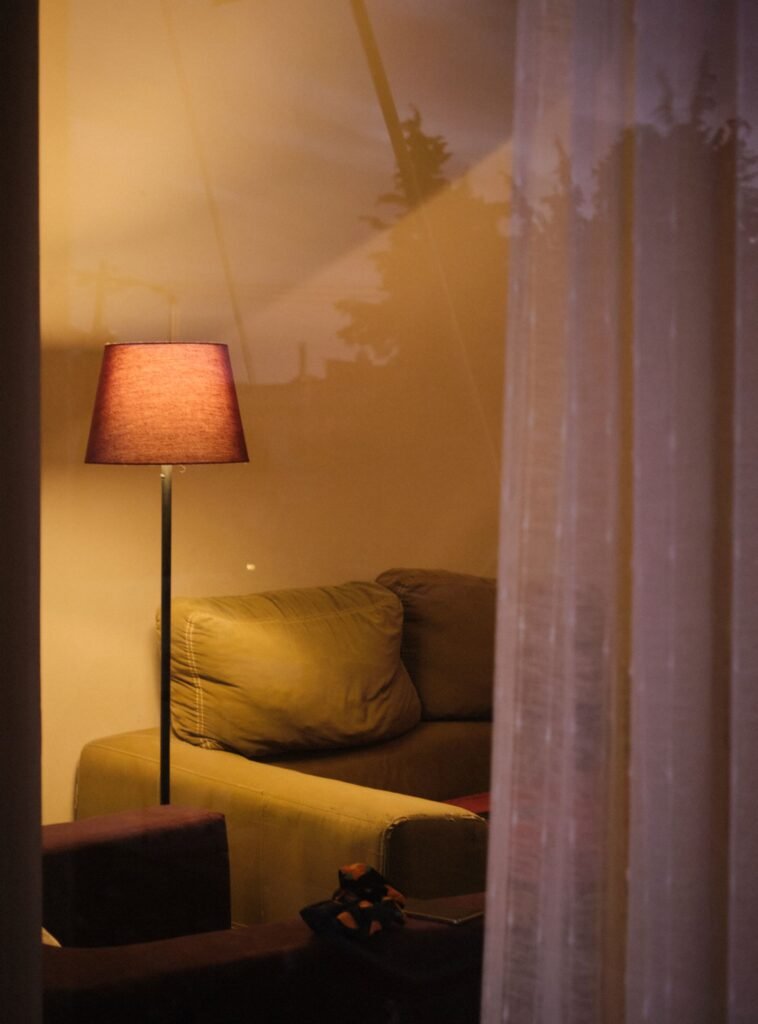
Dark walls swallow light, so lighting matters more here than in a pale room. The rule is simple: warm white bulbs at 2700K, never cool white, and at least three light sources at different heights — a floor lamp by the sofa, a table lamp on a side table, and the ceiling light on a dimmer.
A decent floor lamp costs £25 to £60, a table lamp £15 to £40, and a dimmer switch fitted by an electrician around £40 to £70. That layered warm glow is what makes dark green look rich instead of murky. For the full picture, see our guide to warm lighting for cosy UK homes — and if you want the plants in the corner to survive the gloom, our low-light indoor plant ideas cover the varieties that cope with a dark room.
4. Add texture, not more pattern
A moody room needs touch. Velvet cushions (£12 to £25 each), a chunky knit throw (£20 to £40), a wool rug under the coffee table and a leather or dark-wood tray on the ottoman give the eye something to land on when the walls are quiet. Two or three textures are enough; ten patterned cushions in a small room just look busy.
Keep the biggest soft furnishing — the sofa or the rug — in a mid-tone rather than black. A charcoal sofa against forest green walls disappears; a warm tan leather or deep rust sofa stands out and stops the room going flat.
5. Brass, wood and a little metal
Dark rooms love warm metal. Brass picture frames, a brass floor lamp, cabinet handles or a mirror with a thin brass frame catch the lamplight and stop the room feeling cold. Mix in dark wood — walnut, smoked oak — for the coffee table or media unit.
One metal is a theme; three metals is a jumble. If you already have chrome in the room, swap small pieces to brass gradually rather than all at once. Our guide to mixing metals in home decor explains how to combine gold, silver and black without clashing, and the same rules apply here.
6. One big mirror to borrow light
A small dark room needs one honest mirror, not a gallery of tiny ones. A large arched or rectangular mirror opposite or beside the window bounces daylight across the dark wall and roughly doubles the sense of space. Aim for a mirror at least 60 by 90 centimetres; below that it reads as decoration, not as light.
Lean it on the mantelpiece or hang it above the sofa. In a rented home, a leaning floor mirror needs no holes at all — just a non-slip pad behind the base.
7. Renter-friendly moody: no paint needed
Renters can get 80 percent of the look without touching the walls. Dark curtains in forest green or charcoal (£30 to £60 a pair) change the whole room, especially in winter when they are drawn by 5 pm. Add a dark throw over the back of the sofa, two velvet cushion covers, a dark rug, and warm lamps, and the room reads moody even with magnolia walls behind it.
Peel-and-stick wallpaper in a dark botanical or plain textured print works on one wall too — budget £20 to £40 for a single wall, and it comes off without damage when you leave. Our peel-and-stick wallpaper guide covers the renter-friendly basics.
8. Keep the clutter dark too
The mistake that ruins a moody room is not the paint — it is the bright clutter. A white plastic storage box, a tangle of black cables and a stack of glossy magazines break the spell instantly. Use dark woven baskets (£10 to £20), a lidded wooden box for remotes and chargers, and cable clips behind the TV unit. When everything small is dark, wood or brass, the room looks considered instead of gloomy.
What it costs
- Paint-only refresh (one wall, brushes, rollers): £60 to £120, one weekend.
- Full refresh (paint, two lamps, cushions, throw, mirror): £250 to £500, one to two weekends.
- Renter version (curtains, covers, throw, rug, lamps, no paint): £120 to £250, one afternoon.
Mistakes to avoid
- Painting all four walls near-black in a north-facing room with one small window. The room will look smaller, not cosier.
- Cool white (4000K and above) bulbs. They make dark green look grey and clinical.
- Too many small dark objects. One big dark thing — a wall, a sofa, a rug — anchors the room; twenty small dark things just look messy.
- Ignoring the ceiling. A bright white ceiling above dark walls looks like a lid. Warm white is fine, but a ceiling painted one shade lighter than the walls is better.
FAQ
Does a dark colour make a small living room look smaller?
Not if you use it on one or two surfaces. One dark wall makes that wall recede, which can make the room feel deeper. Four dark walls in a room with little daylight will feel smaller, so keep the other walls warm and pale.
What is the best moody colour for a small UK living room?
Forest green is the safest: it suits Victorian terraces and 1930s semis, works with wood and brass, and looks good in both daylight and lamplight. Inky navy is a close second; charcoal is best in rooms with good natural light.
Can I do a moody living room in a rented flat?
Yes. Dark curtains, a dark rug, velvet cushion covers, warm lamps and one peel-and-stick wallpaper panel give you the look with no paint and no damage. Everything comes down or comes off when you move out.
Will dark walls show marks more?
Matt dark paint shows scuffs a little more than pale paint, especially near doorways. Keep a small pot of the same paint for touch-ups and use a washable matt finish if you have children or pets.
Checklist
- ☐ Pick one feature wall — chimney breast wall or behind the sofa
- ☐ Choose forest green, navy or charcoal; buy one 2.5L tin (£26–£45)
- ☐ Decide on the ceiling: same colour if 2.4m or higher, warm white if lower
- ☐ Three warm (2700K) light sources at different heights, dimmer if possible
- ☐ Two or three textures: velvet cushions, knit throw, wool rug
- ☐ One warm metal accent: brass lamp, frames or mirror
- ☐ One large mirror (60 x 90cm or bigger) near the window
- ☐ Dark storage for clutter: baskets, lidded box, cable clips
- ☐ Live with it a week before painting a second wall
Further reading
- How to Mix Metals in Home Decor: Gold, Silver and Black Without Clashing
- Indoor Plants for Low-Light Homes: Biophilic Ideas That Survive Dark Corners
- Peel-and-Stick Wallpaper: The Renter’s Guide I Wish I’d Had
Paste your AdSense code in Ad Inserter Block 3