
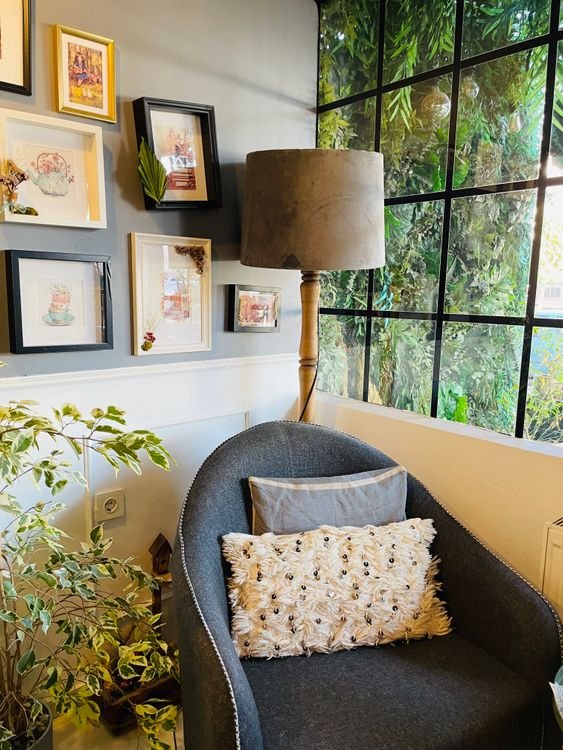

Every home has a corner that is doing nothing. The end of a landing, the alcove beside a chimney breast, the space under the stairs, a bay window full of plants that nobody waters. A reading nook is simply that corner, given a purpose: a comfortable seat, good light, somewhere to put a book and a mug, and enough quiet that you can actually finish a chapter.
You do not need a spare room, and you do not need a window seat built by a carpenter. In a small UK home — a Victorian terrace, a 1930s semi, a rented flat or a box room — the best nooks are the ones that use what is already there. Here is how to find yours and make it work, for anything from £30 to £300.
1. Start with the chair, not the room
A reading nook lives or dies on its seat. You will sit in it for an hour at a time, so comfort matters more than looks. The seat needs three things: support for your lower back, somewhere to put your feet up, and arms at a height that lets you hold a book without your shoulders aching.
In a small space, an armchair of 70 to 80 centimetres wide is the sweet spot — big enough to curl up in, small enough to fit an alcove. A second-hand armchair (£30 to £80 on local marketplaces) with a new cushion and a throw is often more comfortable than a flat-pack chair at twice the price. A pouffe or small footstool (£20 to £40) completes it; without somewhere for your feet, even the best chair gets uncomfortable after twenty minutes.
If you genuinely have no room for a chair, a deep windowsill with a cushion, or a corner of the sofa claimed as yours with a dedicated throw and a side table, counts. A nook is a habit as much as a place. The chair just makes the habit easier.
2. Use the alcove beside the chimney breast
If you live in a Victorian terrace or a 1930s semi, you almost certainly have alcoves — the recesses either side of the chimney breast, typically 60 to 90 centimetres wide and 30 to 45 centimetres deep. They are the single best reading-nook location in a British home, because they are already enclosed on three sides, which feels snug without any building work.
A small armchair fits neatly into a wider alcove, with a wall-mounted reading light above it (£15 to £30, plug-in or battery, no electrician needed) and a narrow side table or a floating shelf for a mug. The other alcove, or the wall above, takes the books: two or three floating shelves (£10 to £20 each) hold thirty to fifty paperbacks and frame the nook beautifully.
In a rented flat, keep it freestanding: a chair, a small table and a leaning bookshelf, all of which move with you. Command strips (£5 to £8) will hold a light picture or a small shelf in most rentals without damaging plaster, but check your tenancy agreement before drilling anything.
3. Turn a bay window into a window seat
Bay windows are common in terraces and semis, and they are wasted on most homes — a couple of plants and a radiator, and nothing else. A window seat uses the bay properly. The simplest version needs no joinery at all: a made-to-measure cushion (60 to 90 centimetres long, £25 to £50) on the sill, if the sill is deep enough and the radiator below is not too hot, plus a cushion or two against the glass and a throw.
The fuller version is a bench: a low storage bench, 90 to 120 centimetres long, placed across the bay, with a cushion on top and books or blankets stored inside. A ready-made storage bench costs £60 to £120, and it solves two problems at once — seating and storage — which in a small home is worth a lot. Add a clip-on reading light or a small cordless lamp (£20 to £45) and the bay becomes usable after dark, which in winter is most of the time.
One practical note: check the radiator. If the bay has a radiator under the window, do not block it with a solid bench — leave a gap for airflow, or the room will be cold and the heating bill will rise. A bench with slatted sides, or one raised on short legs, keeps the heat moving.
4. Claim a corner of the bedroom or the box room
The box room — the smallest bedroom in a terrace or semi, often just 2 by 2.5 metres — is usually a dumping ground. Reclaim one corner of it and it becomes a nook that doubles as a guest room or a study corner. A compact armchair in the corner, a wall-mounted light, and a narrow bookcase (30 centimetres deep, £30 to £60) along one wall is enough. The rest of the room can still hold a single bed or a desk.
In a main bedroom, the nook is often the corner by the window that currently holds a laundry chair. Move the laundry, put the armchair there, and add a small side table. It costs nothing except a reshuffle, and it gives you somewhere to read that is not the bed — which, incidentally, helps you sleep better, because your brain stops associating the bed with wakeful reading.
If space is truly tight, a hanging chair or a large floor cushion (£25 to £50) in a corner works for shorter reads, though it is less kind to your back over an hour. Pair it with a cushion behind your lower back and a footstool, and it is fine for thirty to forty minutes.
5. Light it properly, or it will not get used
A nook with bad light is a nook nobody uses. You need a light that falls on the page, not in your eyes: a reading lamp beside or above the chair, with a warm bulb (2700K), positioned so the light comes over your shoulder. A clip-on book light (£10 to £20) is the cheapest fix; a wall-mounted swing-arm light (£15 to £35) is the neatest, because it folds away when not in use; a floor lamp behind the chair works if you have the floor space.
Natural light matters too, but winter in the UK means most reading happens after dark, so plan for artificial light first. If your nook is by a window, a sheer curtain or a voile (£8 to £15) softens glare in the daytime without blocking light entirely. And avoid putting the nook with its back to the room’s main light — you will be reading in your own shadow.
6. Keep the books close, but not everywhere
A nook needs books within arm’s reach, but a small home does not need a library. A single shelf, a small bookcase or a basket (£10 to £20) holding the five to ten books you are actually reading or about to read is better than a wall of books you will never open. Rotate the stock: when you finish a book, it goes back to the main shelf and the next one comes in.
This is also where the nook earns its keep in a small home. A basket of current reads by the chair stops books migrating to every surface in the house. Add a small side table — even a plant stand or a sturdy stool, 30 to 40 centimetres across — for a mug, your glasses and your phone, and the nook is self-contained. A phone basket or a rule that the phone stays on the side table, face down, is optional but surprisingly effective.
7. Make it cosy with texture, not stuff
Cosiness in a nook comes from texture: a wool throw (£15 to £25), a cushion in a fabric you like touching, a rug underfoot if the floor is cold. A small rug, 60 by 90 centimetres, costs £15 to £30 and makes a hard-floored corner feel like a room. A candle or a cordless lamp adds warm light at a second height.
What cosiness does not need is clutter. A nook with twelve ornaments, four plants and a pile of magazines is not relaxing; it is a shelf you sit next to. Pick two or three things you like looking at — a framed print, a plant that survives neglect (a pothos or a snake plant, £5 to £12), a candle — and leave the rest out. In a small home, every object in the nook should earn its place by being useful or genuinely loved.
8. The under-stairs and landing nooks
Two overlooked spots deserve a mention. Under the stairs, if the space is at least 90 centimetres wide and 1.5 metres tall at its highest point, a small chair and a shelf can fit, though you will need a light — a battery puck light (£5 to £10 for a set) or a plug-in lamp — because under-stair spaces are dark. It suits children especially well, which is a bonus if the nook is meant to get a child reading.
A wide landing, similarly, can hold a chair and a small bookcase at the top of the stairs, turning dead space into the quietest spot in the house. Keep the walkway clear — you need at least 75 centimetres to pass safely — and do not block a fire escape route. If the landing is narrow, a wall-mounted fold-down seat is an option, though it is less comfortable for long reads.
Frequently asked questions
How much space do you need for a reading nook?
About one square metre: enough for a chair 70 to 80 centimetres wide, a small side table and a light. An alcove beside a chimney breast, a bay window or a bedroom corner all provide this without taking a whole room.
What is the best chair for a small reading nook?
A compact armchair, 70 to 80 centimetres wide, with good lower-back support, plus a pouffe or footstool. Second-hand armchairs (£30 to £80) are often the best value. Avoid chairs that are deep but unsupportive — you will slide down and your back will ache.
How do you make a reading nook in a rented flat?
Use freestanding pieces only: an armchair, a small side table, a leaning bookshelf and a cordless or clip-on lamp. Nothing drilled, nothing built in, everything moves with you. A corner of the sofa with a dedicated throw and side table works if there is genuinely no room for a chair.
What lighting is best for reading?
A warm (2700K) light that falls over your shoulder onto the page: a wall-mounted swing-arm light, a floor lamp behind the chair, or a clip-on book light. Avoid a bright ceiling light behind you, which puts the page in shadow, and avoid cool-white bulbs, which feel harsh in the evening.
Your reading-nook checklist
- One comfortable chair, 70 to 80 centimetres wide, with a footstool
- Light over your shoulder: warm 2700K, wall-mounted, floor or clip-on
- A side table or stool, 30 to 40 centimetres across, for a mug and glasses
- Books within reach: one shelf, small bookcase or basket with five to ten current reads
- A throw and a cushion for warmth and texture
- A small rug underfoot if the floor is cold
- One or two things you like looking at — a print, a hardy plant, a candle — and nothing more
- Walkway kept clear: at least 75 centimetres past the nook
A reading nook is not a renovation. It is a chair, a light and a decision: this corner is for reading. Make that decision, and the corner will start paying you back in finished books.
Paste your AdSense code in Ad Inserter Block 3