

Nine years old. Grandma's spare bedroom. The windowsill — I mean, can you even call it a seat?
Not designed. Not comfortable, not even a little. Narrow sill. Cushion flat as a pancake, and I do mean flat, like it had given up years before I got there. Window rattling whenever the wind got ideas. Which was often. That house was drafty in a way new houses just aren't, you know?
But the light. Oh, that afternoon light. Golden, low, the kind that makes dust look pretty.
Nobody bothered me up there. Not once. I read a whole shelf of books in that spot, legs dangling, warm wood under my knees, completely unbothered. I can still feel it, honestly — thirty years on, proper house, proper armchair, and I'm still chasing that exact feeling. That locked-door, nobody-needs-me-for-an-hour feeling. You know the one. Everybody knows the one.
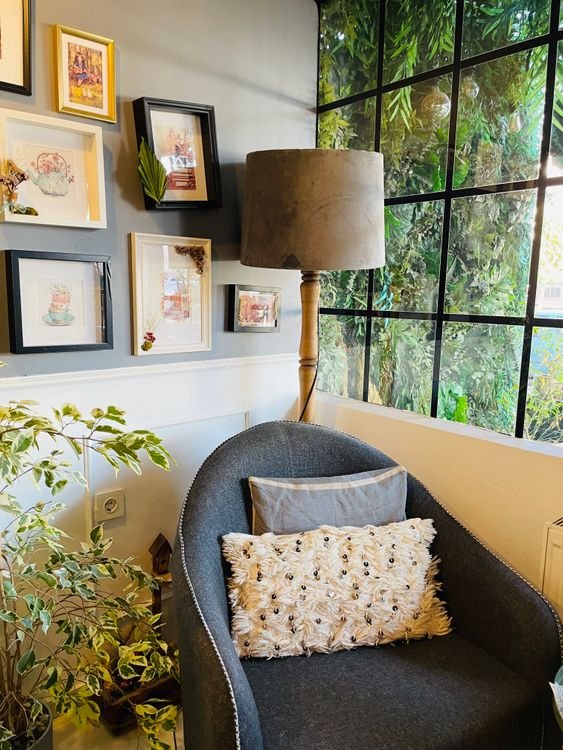
So that's a book nook. Not a library. Not a room. A corner that says sit down, stay a while — in cushions, in lamplight, in that particular quiet.
And here's the good news, the actual good news: you don't need space. You don't need money. You barely need a plan. I've built reading corners in bedrooms, living rooms, hallways — and one deeply questionable spot under the stairs that I still defend to this day. Here's what actually works. For real.
A Nook Needs Three Things. That's It.
People overcomplicate this so badly it hurts. They think built-in bench. Wall of shelving. Rolling ladder, obviously, because apparently we're all in a movie now. Stop. Just stop.
Three things. Sit. Light. Tea spot. Done. That's the list. That's the whole list.
(Want the ladder? Get the ladder. I'm not your boss. I'm just saying you don't need it. There's a difference.)
The seat matters most — I'll get to chairs properly in a minute, because I have Opinions with a capital O — but the rule is dead simple. It has to beat the sofa. That's it. That's the test. If your nook chair loses to your couch, guess what happens? Nothing. You never sit in it. You walk past it daily, feeling vaguely guilty, like that gym membership you swore would be different this time. Ask me how I know. Actually, don't. I know. We all know.
Second: light. The one everyone gets wrong, myself included, for years.
Overhead lighting? Enemy. Instant office vibes, instant "am I at work?" feeling. What you actually want is a puddle of warm light, right where you sit, so the rest of the room just… falls away. Gone. Floor lamp, warm bulb. Little table lamp. Wall sconce if you're feeling fancy. Whatever works. Just warm. And just yours.
Third: a surface. Side table. Stool. Stack of books. Arm of the chair if you're not picky — I'm not picky, the arm counts, fight me. Somewhere for the mug, the current read, your phone. You'll swear you won't check it. You will. Fine. The table forgives you. The table has seen worse.
Everything else? Garnish. Blankets, pillows, rug, art. Beautiful garnish, don't get me wrong. But those three things are the meal. Everything else is parsley. Pretty parsley, but parsley.
The Chair Will Make or Break It
Hot take, and I will die on this hill: chair beats location. Every single time. Great chair in a weird corner beats a mediocre chair in a perfect bay window. I'd rather read in a closet with the right chair than a sunroom with the wrong one. Is that dramatic? Yes. Am I wrong? No.
Slight exaggeration. Slightly. Okay, maybe more than slightly. Whatever.
My nook chair? Sixty bucks. Facebook Marketplace. Overstuffed armchair, faded rust color, looks like it's already heard a thousand stories — because it probably has. The seller said her cat had claimed it and she'd lost the war. Fair enough. I hauled it home in a friend's truck, vacuumed out roughly one entire cat (I wish I were exaggerating), and it's been my favorite seat for three years now. Three years. The couch is jealous. The couch should be jealous.
So what makes a reading chair good? Arms you can actually lean on — not those tiny decorative arms, real arms. A back high enough to rest your head when you're thinking about what you just read, which happens more than people admit. A seat deep enough to tuck your feet up. Fabric that forgives you, because life happens and so does tea.
Leather? Looks great. Cold in winter, sticky in summer, squeaky always. Velvet? Gorgeous. Shows every crumb, every hair, every life choice. A sturdy woven fabric in a medium tone, though — hides a multitude of sins. Including biscuit crumbs I definitely do not leave in mine. Definitely. Not. At all.
Size. Don't go bigger than the corner allows, please, I'm begging you. A massive recliner in a tiny nook looks like a sumo wrestler in a phone booth. Nobody wants that. Measure first. Then get the biggest comfortable chair that fits with a few inches to spare. Inches matter. Inches are everything here.
Truly tiny corner? Floor cushion. Pile of pillows. Done. Some of the best reading spots I've seen are basically nests on the floor, and honestly? Nests are underrated. Humans like nests. We just pretend we don't.
Light It Like You Mean It
Okay. Nerd mode. Full nerd mode, no apologies, because reading light is a real thing you can genuinely mess up, and I have messed it up, in every way possible.
Too dim? Squinting, headache, regret. Too bright? Coziness gone, just like that, poof. Too white? Hospital. You are not in a hospital. You are trying to read a novel. Too yellow? The pages look ancient, like you're deciphering a scroll. Nope. Nope to all of it.
What you want — and this took me an embarrassing number of lamps to learn — is a warm bulb, around 2700K if you're the kind of person who reads the box like I do (I read the box, I read all the boxes), positioned over your shoulder or off to the side. Never in front. Front light glares on the page, and glare is the enemy of everything good. Side and behind washes the page evenly and keeps the room dim. That's the cocoon. That's the whole point. That's the feeling we're buying here.
Floor lamp with an adjustable arm? Gold standard. Aim it at your book and nowhere else — nowhere else, I mean it, the rest of the room can fend for itself. Mine has a brass shade from a flea market. The pool of light it throws is so good I've fallen asleep under it more times than I'll admit. In public. Now. On the record. Whatever.
Table lamps work too, if the side table's the right height, which is a bigger if than people think. Shade roughly at shoulder level when you're sitting. Too high, you're lighting the ceiling. Too low, you're lighting your lap. Come on. Shoulder level. It's not hard. It's just specific.
And please — dimmer. Or a smart bulb. Dialing the light down as the evening goes on? One of life's small luxuries, right up there with fresh sheets and the first sip of tea. Bright for the afternoon chapter. Low and golden for the last fifty pages before bed. If you want the full education on layering light, Living Room Lighting Guide: Layered Lighting Ideas for Every Budget covers it properly, including the budget options that don't look budget. I checked. They don't.
Steal a Bedroom Corner
Most underused nook location in the house? The bedroom. Hands down. People put the bed in, add a nightstand, call it done, and then wonder why the room feels unfinished. But that dead corner by the window? The awkward gap between the dresser and the wall? The one you've been ignoring for years?
That's a reading spot. Waiting. Patiently. I mean — it's literally just sitting there. Being a corner. Hoping someone notices. Poor corner. All that potential, zero attention.
My bedroom nook? Corner by the window. Where I read every single night before sleep. Every night. No exceptions. It's basically a ritual now. Borderline superstition, if I'm honest — skip a night and the whole evening feels off, like I forgot to lock the door or something.
Small armchair. Floor lamp. A side table so tiny it barely fits a mug. And I mean barely — the mug has to commit, fully commit, no wobbling allowed, it's a whole situation. Four feet by four feet. Maybe. Tops. Probably less, if I'm being honest, I never actually measured, I just guessed and then said it confidently. That's how measuring works in my house.
It changed my evenings. Completely. Not a little — completely. Instead of scrolling in bed until my eyes hurt (you know the scroll, the endless thumb-cramping scroll, the one where you don't even remember what you looked at), I sit in the chair and read until I'm drowsy. Then I climb into bed already half asleep. My sleep? Genuinely better. Noticeably. One person commented. One. Still counts. I'm counting it.
I'm not saying it's the chair. I'm saying it's the chair. There's a difference. A subtle, important, legally distinct difference.
Bedroom nooks need calm, though. This is not the place for loud colors or busy patterns — no matter how much you love that one loud cushion. You know the one. We all have one. Mine lives in a cupboard now. It knows what it did. Soft textures. Muted tones. Nothing that shouts. Your brain needs to wind down here, not wake up and start planning tomorrow's meetings. Nobody needs that at 10pm. Chunky knit throw. A cushion in a color you find restful — whatever restful means to you, it's personal, nobody gets to define your restful. Art that's more "misty landscape" than "neon city." You get it. You know exactly what I mean.
If you're rethinking the whole bedroom vibe — and maybe you should be, no judgment, just saying — Bedroom Decor Trends: Cozy Ideas for Better Sleep pairs beautifully with a quiet reading corner. Just saying. Take it or leave it. I'd take it.
One practical note, because practicality matters and somebody has to say it. Small bedroom? Let the nook double as your getting-ready chair. The one where you sit to put on shoes. Wrestle with boots. That whole production. Totally fine. Furniture can have two jobs. Furniture loves having two jobs, probably — I can't ask it, but it seems happy. Just keep a throw on it, so it reads as "reading chair" first and "shoe chair" second. Priority matters. The throw is the uniform. Uniform on? Reading chair. Uniform off? Shoe chair. Simple system. Works.
The Hallway Landing Trick (My Favorite Weird Spot)
Now. My favorite weird location. And I mean weird in the best possible way. The landing at the top of the stairs. That wide bit of hallway nobody knows what to do with — you know the bit, every house has one, it's where the laundry basket goes to die. Slowly. Over weeks. The corner under the stairs. Dead space is the best space for a nook. Nobody expects a reading spot there. Which makes it feel like a secret. And secrets are cozy. That's just science. Probably. I haven't checked. I'm confident anyway.
My friend has a landing nook exactly three feet wide. Three feet! Narrow built-in bench, cushions, a wall-mounted reading light, a little shelf for books. Looks like something out of a cottage in a novel. The kind of novel where people drink tea and solve nothing and it's wonderful. Her kids fight over it. Her husband hides there with coffee on Saturday mornings, and honestly? Good for him. Let the man have his three feet. Three feet of hallway that used to hold a sad plant — a genuinely sad plant, I saw it, it was struggling, it had given up on life — is now the most contested real estate in her house. Forget the kitchen island. The landing bench is where the power is. Power lives on the landing now.
Under-stair spaces? Gold. Pure gold. You know that triangular void under the staircase? Currently storing wrapping paper and regret? And, let's be honest, a broken vacuum? Clear it out. All of it. Out. Low bench or big floor cushion. Small lamp. Cushions piled against the wall, slightly chaotic — that's fine, chaos is cozy here, chaos is the whole aesthetic. The sloped ceiling makes it feel like a den. A hobbit hole for readers. I said it. Hobbit hole. No regrets. Zero regrets.
Kids especially lose their minds over these. My niece has one. She calls it her "reading cave." Best name for anything. Ever. In the history of names. I tried to get her to name my nook too, but she charges for that now. Kidding. Mostly. She did ask for ice cream, though. Negotiations are ongoing.
Small-space nooks work because reading doesn't need much room. A chair's footprint. An arm's reach. That's it. That's the whole square footage requirement. Got an awkward corner anywhere? You've probably got a nook. For more ideas on making tight spaces pull their weight, Small Space, Big Style: Decor Trends for Compact Homes is full of tricks that apply perfectly to nook-building. I'm not just saying that to fill space. I actually use them. Regularly. The tricks work.
Living Room Corners Aren't Dead Space
Every living room has one. Every single one. The corner too small for the sofa. Too awkward for a plant. Currently occupied by nothing — or by a floor lamp that's doing its best. Bless it. It's trying so hard. We see you, lamp. We appreciate you.
That corner wants to be a reading nook. It's been waiting its whole life. Its whole life! Think about that for a second. Years of being a corner. Years of nothing. It deserves better. You know it does.
The move — and this is the move, write it down, tattoo it on your brain — angle the chair into the room. Not flat against the wall. A chair shoved into a corner feels like punishment. Like you're in trouble. Like the chair did something wrong and now it has to think about what it did. A chair angled out at forty-five degrees? Feels like an invitation. It makes this little triangle of space behind it, and your brain reads it as "cozy enclosure" instead of "wasted corner." Brains are weird like that. Useful weird, but weird. Brains, man.
Floor lamp behind the chair. Small side table next to it. And suddenly — I mean suddenly, like overnight, like magic — the dead corner is the best seat in the house. People will fight over it. Guests will migrate to it. You'll pretend to be annoyed. You won't be annoyed. You'll be smug. Rightfully smug.
Open-plan living room? A reading chair can be a room divider. No walls required. Zero construction. Zero permits. Zero drama. Back to the dining area, facing the window or the fireplace. Carves out a quiet zone out of thin air. I've seen it done with a big swivel chair and it's genius. Actual genius, not internet genius. Swivel toward the room when people are over. Swivel toward the window when it's reading time. Furniture that changes its mind is the best furniture. Indecisive furniture. Love it. More furniture should be indecisive.
If the living room needs a general coziness upgrade to support the nook, 10 Cozy Living Room Ideas on a Budget has plenty of low-cost moves. And here's the thing — a nook feels ten times better in a room that already feels warm. Ten times. At least. Probably more. It's the difference between a reading corner and a chair that's just… there. Existing. Sadly. In a corner. Don't do that to a chair. Chairs have feelings. Probably.
Kids' Nooks: Lower Everything
Kids don't want your armchair. They just don't. They want a nest. The lower and squishier, the better. That's the rule. That's the only rule. Write it on the wall. My niece's reading cave — the under-stair one, the famous one, the one with the name — is a thick floor cushion, a pile of pillows, a string of warm fairy lights, and a basket of books. She is seven. Seven! She has better reading habits than most adults I know. And I know a lot of adults. Coincidence? I think not. I refuse to think it. Refuse.
Here's what I learned from watching her, because kids teach you things if you shut up and watch. Everything has to be at their height. Their height, not yours. Stop putting things on high shelves. They can't reach. That's the whole problem, right there, that's why they don't read — they literally cannot get the book. Books they can reach without asking. Without asking! Independence matters. Light that's warm and a little magical — not bright, not white, magical, there's a difference and kids can tell. And a boundary, even a symbolic one. A curtain. A canopy. A rug that marks "this is the reading zone," like a tiny country with its own laws and its own flag, probably. Kids love a defined space. It makes reading feel like going somewhere, not just sitting somewhere. Going somewhere is exciting. Sitting somewhere is homework. Nobody likes homework. Except maybe two people. They're weird.
Fairy lights are the cheat code. I cannot stress this enough. Cannot. A twenty-dollar string of warm white lights, and any corner becomes an event. An event! Drape them along a shelf. Around a window frame. Across the top of a little tent. My niece's cave has them on a timer, so they come on at reading time, and she treats it like the room is waking up for her. Like the room cares. Like the room planned this. Honestly? She's right. The room does care. Or it should. Rooms should care more, generally.
And let them choose the cushions. I mean it. Really mean it. Like, actually mean it, not pretend-mean-it. My niece picked the most violently patterned cushions in the store. Clashing colors. Different sizes. Total chaos. The kind of chaos that makes adults twitch. In her little cave, they look perfect. It's her space. The clashing is the point. The clashing was always the point. It was never about matching. It was about choosing.
The Textures That Make It Feel Like a Hug
A nook lives or dies on texture. I'm serious about this. Dead serious. Hard surfaces feel like waiting rooms — you know that feeling, the plastic chair, the clock ticking, the weird smell, nobody wants that at home. Nobody. Soft surfaces feel like invitations. This is the garnish I mentioned earlier, way back at the start, remember the garnish? It's the garnish that makes people actually sit down. Garnish with a job. Working garnish. Garnish that earns its keep.
Start underfoot. A small rug, even a 3×5, changes the whole feeling of a corner. It says "this spot is deliberate." It says "someone thought about this." It says "a human lives here and they care about feet." It warms the floor for bare feet, which matters more than you'd think — cold floors are the enemy of tucked-up feet, and tucked-up feet are the whole point of reading. The whole point! Nobody tucks their feet up on a cold floor. Nobody. Ever. It's physically impossible, emotionally speaking. Science. Probably.
They just don't. Physically impossible, emotionally speaking. Science. Probably. Anyway — then the throw blanket.
Every nook needs one. Non-negotiable. Draped over the arm of the chair, ready to deploy at a moment's notice, like a fire blanket but cozier and with fewer emergencies. And honestly, if your throw isn't ready to deploy, is it even a throw? It's a decoration. We don't do decorations here. We do tools. Cozy tools.
Chunky knit. Waffle weave. Something with weight — real weight, the kind that stays put when you move, unlike those thin decorative throws that slide off the second you breathe near them. Those are worse than no throw at all. I said it. Worse. Out loud. You want the one you actually reach for, every time, without thinking. Without deciding. Your hand just goes there. Mine is a cream waffle-weave thing, washed fifty times, looks better for it. Fifty washes! It has earned its place. It has tenure. It has a pension plan. Probably.
Pillows next. One for your back. One for your side. Maybe one to hug, if that's your thing — no judgment here, none at all, I'm a hugger, I hug pillows, I hug chairs, I hug the concept of comfort, I hugged a particularly good blanket once and I'm not sorry.
And if you really want to go full cocoon — and why wouldn't you, commitment is beautiful, half-measures are for other rooms — a curtain. Or a room divider behind the chair. Cuts the visual noise of the rest of the room, all that clutter, all those dishes you can see from here, all that laundry judging you silently. Makes the nook feel like its own little world. Its own country. With its own laws. Law one: no chores visible. Law two: tea is mandatory. Law three: I haven't decided yet, I'll get back to you, it's a young country.
I hung a simple linen curtain behind my bedroom nook chair and the difference was instant. Instant! Same chair. Same lamp. Completely different feeling. Like I'd built a room inside a room. A room-ception. I sat down, pulled the curtain, and thought: oh. Oh, this is different. This is a place now. This is somewhere. I actually said "oh" out loud. To nobody. The curtain heard me. The curtain understood.
Stuff People Ask Me
My friend's landing nook is three feet wide and the most contested seat in her house. My coworker built one in a basement — a basement! My sister's chair became a chairdrobe, which is a tragedy in three acts, possibly four, I'm still counting. The five questions, answered. Finally. Let's go. Buckle up. Again.
"How much space do I actually need?" — less than you think. Way less. Less than that, even. Less than you're picturing right now. Honest minimum: your chair's footprint, plus about a foot on one side for a table or a stack of books. Standard armchair, that's roughly four by four feet. I measured mine once out of curiosity — because I'm that person, I measure things out of curiosity, I measure things nobody asked me to measure — and it was barely bigger than that. Barely. I was surprised. I shouldn't have been. Chairs are smaller than you think. Corners are bigger than you think. Math is weird.
No four-by-four to spare? Go floor-level. Big cushion against a wall, small lamp, basket for books. About three feet by two feet. Smaller than most doormats are long. Think about that. Your reading spot could be smaller than a doormat. A doormat! Walk around your house this weekend. Seriously, this weekend, put it on the list, right after "buy milk" and before "regret nothing." Look for dead corners with fresh eyes. Between the bookshelf and the wall. The end of the hallway. That weird spot by the front door where the mail piles up — you know the spot, the mail mountain, we've all got one, it's a universal constant. One of those is your reading spot. It's been waiting. Patiently. This whole time. Poor corner. All that potential.
"What if there's no window?" — my coworker built a nook in her basement. One tiny window, size of a shoebox. A shoebox! I told her it would never feel cozy down there. I was confident. I was wrong. Admitted it to her face, which cost me — she brings it up at every dinner, and honestly, fair, I earned that, I walked right into it, I gift-wrapped that mistake and handed it to her.
Her secret was going all-in on the lamp. Really good floor lamp, warm bulb, the whole thing, no half measures, no "I'll upgrade later," all-in from day one. Because the basement is naturally dark, the pool of light feels even more dramatic. Like reading in a theater. A theater where the play is your book and you're the only audience member and it's wonderful and nobody talks during the movie. She added a big mirror opposite the lamp to bounce the light around, a rug to warm the floor, and now it's her favorite room in the house. Her words, not mine. I quote her because I can't say it better. I tried. I failed. Her words win.
So no. You don't need a window. You need good light and the confidence to make the darkness part of the vibe — the darkness isn't the problem, it's the atmosphere, it's the whole mood, lean into it, hug it, make it yours. Some of the best reading happens in the dark with one perfect lamp. Ask anyone who ever read under the covers with a flashlight. They'll get it instantly. They always do. There's a nod. A knowing nod. You'll see it.
"What's the best chair for a small nook?" — story time. Buckle up. Again. When I was hunting for my nook chair, I sat in probably thirty chairs. Thirty! Big ones. Small ones. Expensive ones that felt like sitting on a cloud made of money — a very expensive cloud, a cloud with a payment plan, a cloud that judges your bank account. The one I brought home was sixty bucks from Facebook Marketplace. Sixty. Bucks. I still can't believe it. Sometimes I tell people and they don't believe it. I show them the chair. They believe it then. The chair speaks for itself.
Why it won — and this is the important part, the actual criteria, forget the price tag, price tags lie — arms the right height to lean on without hunching. Seat deep enough that I can tuck my feet up sideways, which is how I actually sit, legs everywhere, like a teenager, like a person who has never heard of posture and never wants to. And small enough that it doesn't eat the corner. It respects the corner. The corner respects it back. Mutual respect. Beautiful.
My advice: sit in the chair the way you'll actually read, not the way the showroom wants you to sit — showrooms lie, showrooms want you perched, showrooms are not reading, showrooms are standing in a bright room being watched by a salesperson. Tuck your feet up. Lean on the arm. Slouch. Full slouch. Maximum slouch. If the chair fights any of that, it's not your chair. Move on. There are other chairs. There are so many chairs. The world is full of chairs. You'll find yours.
And don't overlook secondhand. Reading chairs get better with a little wear — they soften, they learn your shape, they become yours in a way new chairs take years to manage. Years! A brand-new chair looks like it's waiting for permission. A broken-in chair looks like it's been expecting you. There's a difference. A big one. A huge one. You can feel it the second you sit down.
"How do I stop it becoming a junk chair?" — oh, the chairdrobe. We all know the chairdrobe. That bedroom chair where clothes go to be neither clean nor dirty. Just… in transition. In limbo. In purgatory, honestly. Clothes purgatory. My sister's reading chair became a chairdrobe within a week. A week! She called me, furious at herself, like the chair had betrayed her personally. Like the chair had chosen this life. Like the chair woke up one morning and said "you know what, I'm a wardrobe now." Chairs don't do that. People do that. To chairs. Rude.
Here's what fixed it. One rule. Just one. The throw blanket lives on the chair, always. Always always always. If the blanket is there, the chair reads as "occupied" and your brain won't put clothes on it. Psychological trick. Works embarrassingly well — embarrassingly, because it's so simple you feel silly for not doing it sooner, and I did feel silly, and my sister felt silly, and we were both silly together, and it worked anyway.
Second rule: the side table gets cleared every night. Thirty seconds. That's the whole chore. Thirty seconds. Mug to the kitchen, book stays, phone goes to charge. A nook with a clear table invites you in — it says "come sit, I saved you a spot," it says "I was thinking of you." A nook with yesterday's stuff on it feels like a chore. Feels like homework. Nobody wants homework in their reading corner. Nobody. Homework lives at the desk. The desk can have it.
My sister's chair has been clothes-free for four months. Four months! The blanket trick did most of the work. She still feels guilty walking past it. The good kind of guilty. The "I should go read" kind. The best kind of guilt there is, honestly. Guilt that makes you read? That's not guilt. That's a feature.
"Do I need a bookshelf in the nook?" — nope. Nice, but not required. Not even close to required. Not required at all, actually, let me be clear. For two years my nook had no shelf at all. Two years! I kept a stack of books on the floor next to the chair. Sounds messy. Actually looked kind of great — a little tower of current reads, leaning slightly, very "person who reads," very intentional-accidental, very "I meant to do that."
Then I put up one floating shelf at arm's height. Just one. Holds about fifteen books. Plenty. More than plenty. Nook shelving should hold your current rotation, not your whole library — your whole library lives elsewhere, it's fine, it has its own room, probably, or its own wall, or its own existential crisis, libraries have those too. Five to fifteen books. The ones you're reading now, the ones you're reading next, and the one you've been "about to start" for six months. We all have that book. Mine's been on the shelf for a year. A year! I'll get to it. Probably. Eventually. Maybe. Don't hold your breath. Hold a different book.
Anyway. One shelf, a small basket, a floor stack. Don't build a library around a chair. Build a chair, then give it a few friends. Chairs need friends. Books are excellent friends. Low maintenance. Quiet. Occasionally life-changing. What more do you want from a friend, honestly?
So that's the book nook. Three things, a good chair, warm light, and the confidence to claim a corner — claim it, like it's yours, because it is, it's your house, claim the corner, plant a flag, metaphorically, please don't actually plant a flag in your living room, your family will have questions. You don't need a big house or a big budget. You need four square feet and the willingness to sit down. That's it. That's the whole requirement. My grandma's windowsill taught me that thirty years ago. My rust-colored Marketplace chair teaches me again every night. Every single night. It never gets tired of teaching. I never get tired of learning. Mostly.
Find your corner. Put a chair in it. The books will do the rest. They always do. They've been waiting too.
Paste your AdSense code in Ad Inserter Block 3