
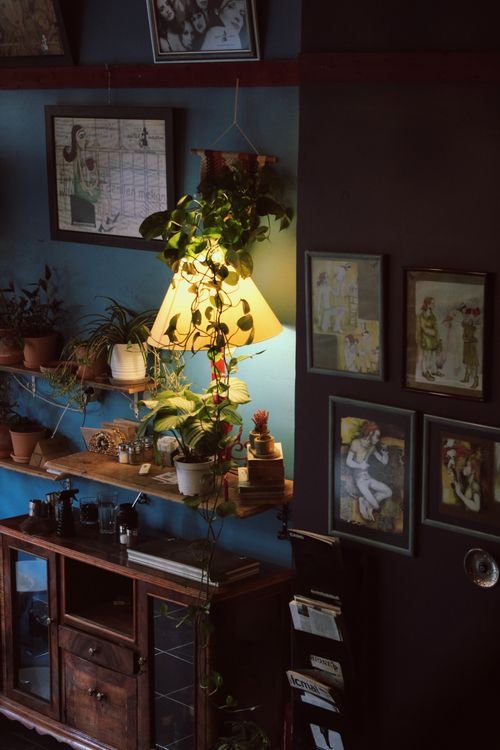

My aunt Rania's living room should not work.
Victorian armchair. Jammed right up against a Danish modern sideboard.
Kilim rug under a glass coffee table. Brass candlesticks on a concrete shelf.
On paper? A mess.
In person? I walked in and just stood there. Didn't even take my shoes off. Just stood there like an idiot.
It doesn't feel decorated. It feels lived in.
Every object has a past. You can sense it.
Like each thing picked its own spot and refused to move. Stubborn things. I respect that.
A friend walked in, looked around, and said, "It's nice."
You know that tone. The one people use in hospital waiting rooms. Or at funerals.
That was my first apartment, by the way. One weekend. One store. Everything bought together in a panic because my lease started Monday.
Beige. On beige. On more beige.
The couch. The rug. The curtains. Even the lamp shade, somehow.
Nice. Ouch. Still stings.
So what IS eclectic supposed to do, then? No wait — let me back up.
The collected-over-time look. On purpose.
That last part? The whole game.
Skip it and you're just… accumulating.
Actually, accumulating is generous. Hoarding, but with better lighting. Ha. No — accumulating. I'll be nice.
Because "collected" and "garage sale" live dangerously close to each other.
One bad lamp apart, honestly. I have seen that lamp. It was a ceramic dolphin. Don't ask.
I learned the difference at family dinners. Ten years of grilling my aunt. Maybe eleven. I lost count around the third time she re-told the sideboard story.
She finally gave me actual rules. Not "express yourself" fluff. Real ones.
I wrote them down. Actual notebook. Pen. The works. My cousin laughed at me. Whatever.
"Eclectic" Is Not Code for "Random"
I got this wrong for years. Thought eclectic meant throwing random stuff together and crossing your fingers.
That's not a style. That's a storage unit with nicer lighting.
If there's no reason behind a piece, the room knows. Trust me. It knows.
Her room? Every piece different. Every piece chosen. I know because she's told me the story behind each one. Twice. Minimum.
That Victorian chair didn't land there by accident. Estate sale. 1998. Sixty bucks, she says. Sixty. And she's told that story at every dinner since.
Reupholstered twice since. Ask my aunt about it and you'll get the full saga. Whether you wanted it or not.
She'll tell you about the torn seam. The fabric guy who retired mid-job. To Florida.
Left the chair sitting in his shop for three months. She still hasn't forgiven him. Honestly? Fair.
The Danish sideboard was her big splurge in 2005. Fourteen hundred dollars.
She still mentions the price when anyone admires it. Every single time. "Fourteen hundred," she'll say, before you even finish the compliment.
The kilim? Came home from a trip, rolled up in her suitcase like a burrito.
Customs probably thought she was smuggling a rug. She was. Sort of.
She told me she declared it as "a blanket." A blanket! That woman.
Nothing matches. Everything belongs. Because she picked each thing for a reason. And she knows the reason.
Can you say that about your stuff?
I tried that test on my own flat once. Pointed at things. Asked myself why each one was there.
Half my answers were "it was on sale." Ouch. Again.
It looks spontaneous, her room. It isn't. I watched her move one lamp three times in an afternoon.
Three times. Spontaneity? Please. That's rehearsal.
Take the rehearsal away and what have you got? A garage sale. With candles.
The 80/20 Rule (Pick a Lane, Then Break It)
My aunt dropped this on a phone call. I took notes like a nerd. Actual notebook. Pen. The works.
My phone was on speaker. My cat knocked the notebook off the table halfway through. I still have the dented page.
She didn't give me a rule, though. She walked me through her room. Over the phone. Like a tour guide who couldn't point.
Most of it, she said, is just warm wood. Old shapes. Nothing shouting. Calm stuff. The kind of furniture that minds its own business.
Then the lamp. Sculptural. Modern. Makes zero sense and complete sense at the same time.
That's the wink, she said. The joke only the room gets.
I didn't get it yet. Not really. Then I went to a friend's housewarming.
Her living room was forty percent farmhouse, thirty percent boho, twenty percent mid-century, and ten percent "found it on the curb."
I counted. Roughly. On my fingers. She caught me. Awkward. Whatever.
It felt like channel surfing at 2 a.m. Nothing to land on. Just noise.
Her room: one lane, one joke. My friend's room: five lanes, no joke.
That was the whole difference. Not money. Not taste. Just that.
And — good news — the lane doesn't need money.
My aunt's lane is mostly secondhand wood furniture in warm tones. Nothing precious.
A scratched side table. A chair with a wobbly leg she fixed with a folded coaster.
A coaster from a pizza place. It's still there. I checked last month.
Same tones, same wood, over and over. That's what made it look meant, not the price tag.
I saw the opposite at a colleague's flat. One designer chair. Cost more than my sofa.
Around it? Nine random things. The chair looked lost. Like a tuxedo at a barbecue where nobody told the guy. You know? That guy.
Give me the thrifty room. Every single time.
Color Is the Glue That Holds It Together
I stood in her doorway once and counted. On my fingers.
Green, for the chair. Warm brown, for the wood. Cream, for the kilim. Brass, for everything else.
Four families. That was the whole room. Twenty years, same four.
The Victorian chair got reupholstered in green velvet that picks up the plants.
The kilim carries cognac and cream. Brass candlesticks echo the brass floor lamp.
Different centuries. Different continents. Same conversation. They'd get along at dinner.
The chair and the lamp? They'd split dessert. I'm sure of it.
I walked the room once, slow, like a tour. Terracotta pot by the window. Olive throw on the chair arm. Warm beige walls. A clay bowl on the shelf. Deep brown wood everywhere.
Nothing matched. Nothing clashed either. Weird. Cousins at a reunion, the kind who actually like each other. Rare. But it happens.
I went deep on this in Earthy Color Palettes: The Warm, Grounded Hues Defining Homes in 2026.
She told me she bought the kilim on a trip and never once worried it wouldn't fit. "It had the colors," she said. Like that settled it.
It did.
I watched her do the same check at a flea market. Held up a vase. Pretty. Blue, though.
Checked her phone. Shook her head. Put it back down. "Not my colors," she said.
The vase was on clearance. She walked away anyway.
Clearance is where good rooms go to die. I'm serious. Walk away.
Same four, twenty years running. Not bored. Just right.
Repeat One Thing and Watch It Work
I was waiting for dinner at her place once. Bored. My eyes wandered.
Candlesticks first. Then my eyes jumped to the floor lamp — same brass. The frames after that. And the tray on the coffee table, brass again.
Hop. Hop. Hop. I didn't plan that route. My eyes just took it.
Four eras, four styles, one metal.
And suddenly the room felt… meant. Not gathered. Meant. Like someone had tied a thread through it and I'd just found the end.
I tried it at my place after. Wood tone first. Coffee table. Frames. A bowl I already owned.
Eh. Fine. It helped. A little.
Black metal next. Lamp, curtain rod, side table legs. Same story. Fine. Not magic.
Then I tried round. Round mirror. Round coffee table. And the pendant light.
Two, three repeats. That's it. Suspiciously easy. Almost feels like cheating, honestly.
Old-plus-new? Same deal. When you mean it, anyway. A vintage piece and a modern piece in the same wood tone? They stop competing. Start conversing. I wrote a whole piece on this called The Vintage-Modern Mix: How to Blend Old and New Pieces in 2026.
Same core idea. Find the thread connecting them — usually color or material — and let that thread carry the weight. The contrast turns interesting. Instead of confusing. It stops being a clash. Starts being a conversation.
Every Room Needs One Weird Thing
Blunt opinion time. Every eclectic room needs one object that makes guests stop. And ask. Stop mid-sentence. Ask.
One. Not five. One.
My aunt has this enormous carved wooden mask on her hallway wall. Dramatic. A little intense. My cousin refuses to sit facing it. Every person who walks in asks about it, though. Every single one.
It hands the whole house personality. No matching furniture set ever could. It's the exclamation point at the end of the room's sentence. The room's signature. Its autograph.
Your weird thing can be anything. Neon sign in a traditional dining room. Giant abstract painting over a vintage dresser. Sculptural chair that looks museum-bound. Pick your poison.
Or a collection. Something specific. Slightly obsessive. Vintage cameras. Ceramic pineapples. Whatever. The weirder the collection, the better the story.
My friend keeps a full suit of decorative armor in the corner of his otherwise normal living room. Normal couch. Normal rug. Armor. Weird? Extremely. Does anyone forget his living room? Never. Not once.
One per room, though. Two weird things start fighting. Three? You're running a museum gift shop. And nobody wants to live in a gift shop.
Let one object be the star. Everything else is supporting cast. The supporting cast matters. Nobody came for the supporting cast. They came for the star.
Plants Count as a Style
Cheat code nobody talks about. Plants make eclectic rooms work harder than almost anything else. Harder than the rug. Harder than the art. Seriously.
Greenery goes with literally everything. Victorian. Modern. Boho. Minimalist. Industrial. No style exists that a plant clashes with. None. Zero.
It's the Switzerland of decor.
My aunt has eleven plants in her living room. Eleven. I counted last Eid. Fiddle leaf fig in the corner — barely surviving, but surviving. Pothos trailing off the bookshelf. Snake plant by the chair. Little succulents on the sideboard. Eleven green things. One room.
Here's what they do in a mixed-style room. They fill the gaps. The visual gaps between pieces that don't match. Your eye travels across the green. Gets stuck nowhere. Just glides.
They also add the one texture factory furniture can't fake. Life. Actual living green stuff. Not plastic. Not a print.
A room full of mixed styles can start feeling like a furniture showroom. If everything in it came from a factory. One big leafy plant breaks that instantly. It says a human lives here. And waters things. And occasionally forgets to water things.
If you want to go deeper, Biophilic Design 2026: How to Bring Nature Into Every Corner of Your Home is all about weaving the natural world through your rooms. Eclectic spaces might benefit most of all. More styles to soften. More gaps to fill.
Start with the unkillable ones if you're nervous. Pothos. Snake plant. ZZ plant. My aunt's oldest pothos is older than me. Older than my driving license. Older than some of my friendships.
It's seen things. Still going.
Thrift It Before You Buy It New
Eclectic design and thrift stores were made for each other. Convinced. Soulmates. Whatever you want to call it.
The whole point of eclectic is pieces with character and history. And you can't buy history at full retail. You find it. Thrift stores. Estate sales. Flea markets. Your grandma's attic. Your neighbor's curb on moving day.
My best eclectic piece cost fourteen dollars. Brass table lamp from the seventies. Heavy as a brick. Beautiful patina. Found it at a thrift store on a Tuesday morning. Rain. Nobody else in the store. Secret best time to go, by the way.
Weekend pickers have come and gone. New stuff is out. I rewired it myself. One hour. One video tutorial. Burned my thumb slightly. Worth it.
It's the thing in my living room that gets the most comments. Fourteen dollars. I've spent more on lunch. On one lunch. Last week.
Thrift-first also protects you from the biggest eclectic mistake. Buying everything at once. When you thrift, you build slowly. Lamp in March. Chair in June. Rug in October. Slow. Patient. Slightly obsessive.
That slowness IS the aesthetic. Collected-over-time can't be faked in a weekend. It can absolutely be built over a year of good hunting. A year of Tuesdays.
For stretching a small budget into big style, Budget Decor: Big Style, Small Spend has the full playbook. Eclectic on a budget isn't a compromise. It's the native habitat. The home turf.
One warning. Thrift stores will tempt you with things that don't fit your palette. That purple velvet chair is gorgeous. It will ruin your life. I almost brought one home in April. Stood in the aisle. Holding it. Thinking. Put it back.
Check every find against your color list. Doesn't speak your colors? Walk away. Even if it hurts. Especially if it hurts.
I have left beautiful things behind. I think about them the way people think about exes. Fondly. Briefly. With relief.
The Line Between Collected and Cluttered
So how do you know when you've crossed it? When does "eclectic" turn into "messy"? When does the magic tip over?
I've crossed the line myself. Had to walk it back. Embarrassing. Educational.
Here's what I learned.
The test is breathing room. Every object needs a little space around it. Not a lot. Just enough that your eye sees it as one thing. Instead of part of a pile. One thing. Not a pile.
My aunt's sideboard has five objects on it. Five. A lamp. A stack of books. A plant. A bowl. A framed photo. Each one has room. Room to breathe. Room to be itself.
When I tried copying the look, I put eleven things on my sideboard. Eleven. Looked like a yard sale. I removed six. Suddenly it looked like hers. Same objects. Different air. That's all it took.
Test number two: the squint test. Stand in the doorway. Squint until everything's blurry. Three to five big shapes? Calm color wash? You're good.
Visual static — like TV snow made of furniture — too many small things competing. Too many voices. All shouting.
Eclectic rooms need a few big confident pieces to anchor all the little interesting ones. Big sofa. Big rug. Big art. Then the quirky small stuff gets to dance around them.
Edit. Ruthlessly. Twice a year, my aunt strips her living room bare. Everything off the shelves. Onto the floor. In piles. Then she puts back only what she loves. Truly loves. The rest? Donated. Gone. Out the door.
She calls it "the harvest." Brave. Honestly? Terrifying the first time I watched.
She held up a vase she'd owned for a decade. Looked at it. Put it in the donate box. Didn't blink.
Didn't even blink. I blinked. Twice. For both of us.
But she's right, though. A room like that? It's a living thing. And living things need pruning.
Otherwise — wild. Just… wild. Into clutter.
Haven't noticed an object in a month? Hmm. Might be time. Time for it to find a new home.
A month of invisibility? That's the object telling you something. Listen. Seriously. Listen.
Stuff People Ask Me
Eclectic questions arrive constantly. At dinners. In DMs. From strangers who saw my aunt's living room on a video call. Here are the ones I get most.
"How do I start going eclectic if all my furniture matches?" — my cousin was in exactly this spot. Bought one of those matching bedroom sets in her twenties. Everything the same dark wood. Bed. Dresser. Nightstands. All of it. By thirty she was bored out of her mind. Staring at the same wood every morning. But she couldn't afford to start over. Who can? So she didn't. She started with one thing. A vintage rug from Facebook Marketplace. Eighty bucks. Gorgeous faded Persian-style thing in rust and cream. Frayed at one corner. She put it under the bed. Just like that, the matching furniture stopped looking matchy. It looked like a backdrop. A stage. Then she swapped the matching lamps for two different thrifted ones. One brass. One ceramic. Then a chair from her mom. Old. Comfortable. Ugly in a lovable way. Two years later, you'd never know it started as a set. Never. Her advice? I steal it constantly. Don't replace everything. Disrupt one thing at a time. One rug. One lamp. One chair. Let each new piece argue a little with the old stuff. That argument? The whole style. The friction is the point.
"Can you actually mix wood tones? Like, really?" — my neighbor's dining room answered this for me permanently. One dinner party. That's all it took. Oak farmhouse table. Walnut mid-century chairs. Teak sideboard. Three woods. One room. I spent the whole dinner trying to figure out why it worked. When everything I'd read said it shouldn't. Everything. All of it. Wrong, apparently. I kept staring at the table legs. Then the chairs. Then the sideboard. Here's what I figured out — somewhere between the main course and dessert, and, uh, a second helping of whatever that was. Her tones are all warm. Oak. Walnut. Teak. Different depths. Same temperature. That's the trick. Warm woods play together. Cool woods play together. Mix a warm honey oak with a cool gray-washed piece? Awkward. Instantly. Like two people at a party with nothing in common. Standing in the corner. Quiet. She also repeats each tone at least twice. Walnut chairs echo a walnut frame on the wall. Oak table talks to the oak floors. Nothing's lonely. Every tone has a friend. So yes. Mix them. Keep the temperature consistent. Give every tone a friend. Because lonely tones? They look lost. Lost and a little sad.
"How many styles can you mix before it's too many?" — oh, I have a cautionary tale for this one. A friend of mine went eclectic. Hard. Her living room became — her words, not mine — "coastal farmhouse boho with mid-century accents and a little bit of industrial." I counted that description once. Six styles. Six. That's not a style. That's a ransom note. Every piece from a different universe. None of them talking to each other. Just coexisting. Awkwardly. I finally told her — gently, over wine, second glass — that she needed two anchors. Two styles as the main characters. Everything else auditions for a supporting role. Most pieces don't get the part. She picked boho and mid-century. Moved the farmhouse stuff to the guest room. Sold the industrial lamp. To someone else, presumably. Suddenly the room made sense. Like someone turned the focus knob. The rule I took from it? Two anchor styles. Max. You can sprinkle in a third as an accent. A single object. One. But the room needs to know what it is at its core. Two anchors. One accent. That's the formula. Tattoo it somewhere.
"Isn't eclectic just clutter with better PR?" — this one I get more than any other question. Usually from someone standing in my aunt's living room looking suspicious. Arms crossed. Eyebrow up. And look. I understand the suspicion. The line is real. And it's thin. Thin as thread. But here's the difference. Clutter is unintentional. The mail pile. The chair covered in clothes. The drawer that won't close. Nobody chose any of it. It just happened. Eclectic is the opposite. Every piece was chosen. Placed. Given room to breathe. My aunt can tell you where every object came from and why it's there. The chair? Estate sale, 1998. The mask? Hallway. Don't ask. Ask a cluttered person about the pile on the dining table and they'll say "I don't know, it just accumulated." That's the whole distinction. Right there. Intention. An eclectic room is edited. A cluttered room is just happening. If your room looks eclectic in photos but feels stressful in person? Hmm. Probably clutter. Wearing an eclectic costume. Edit it like my aunt does. Twice a year. Be brave. The donate box won't bite.
"What's the cheapest way to try eclectic style?" — thrift stores. Estate sales. Your own family's cast-offs. In that order. My fourteen-dollar brass lamp is still my best example. Still. After all these years. But here's the fuller playbook I give people. First, raid your relatives. Every family has an aunt or grandma with an attic full of interesting things they're dying to get rid of. Dying. My aunt furnished half her hallway with my grandmother's cast-offs. Best pieces in the house. Free. Second, learn your thrift store's restock day. Go on weekday mornings. Tuesday, in my experience. Third, set up Facebook Marketplace alerts for the specific things you want. Not "furniture." Specific. "Solid wood side table." "Brass lamp." I got a solid wood side table for twenty-five bucks from a woman who just wanted it gone before her move. She practically carried it to my car. Total starter kit: one vintage lamp. One interesting chair. One real-wood side table. One piece of art that isn't a mass-produced print. Under a hundred dollars if you're patient. Patient is the key word. The style was basically invented by people with more taste than money. You're in good company. Great company, actually. The best company.
So. That's eclectic. As taught to me by my aunt over roughly a decade of family dinners. And one very patient phone call where I took actual notes. Pen. Paper. The works.
Start with your colors. Pick your eighty percent. Add the twenty percent that makes it yours. The weird twenty. The personal twenty. Give everything breathing room. And find your one weird thing.
The object that makes people ask questions. That stops guests mid-sentence.
A room without a story? Just furniture. Four walls and stuff. My aunt's living room has about forty stories in it. Forty. At least. Probably more by now.
Yours can too. Start collecting them on purpose.
Paste your AdSense code in Ad Inserter Block 3