
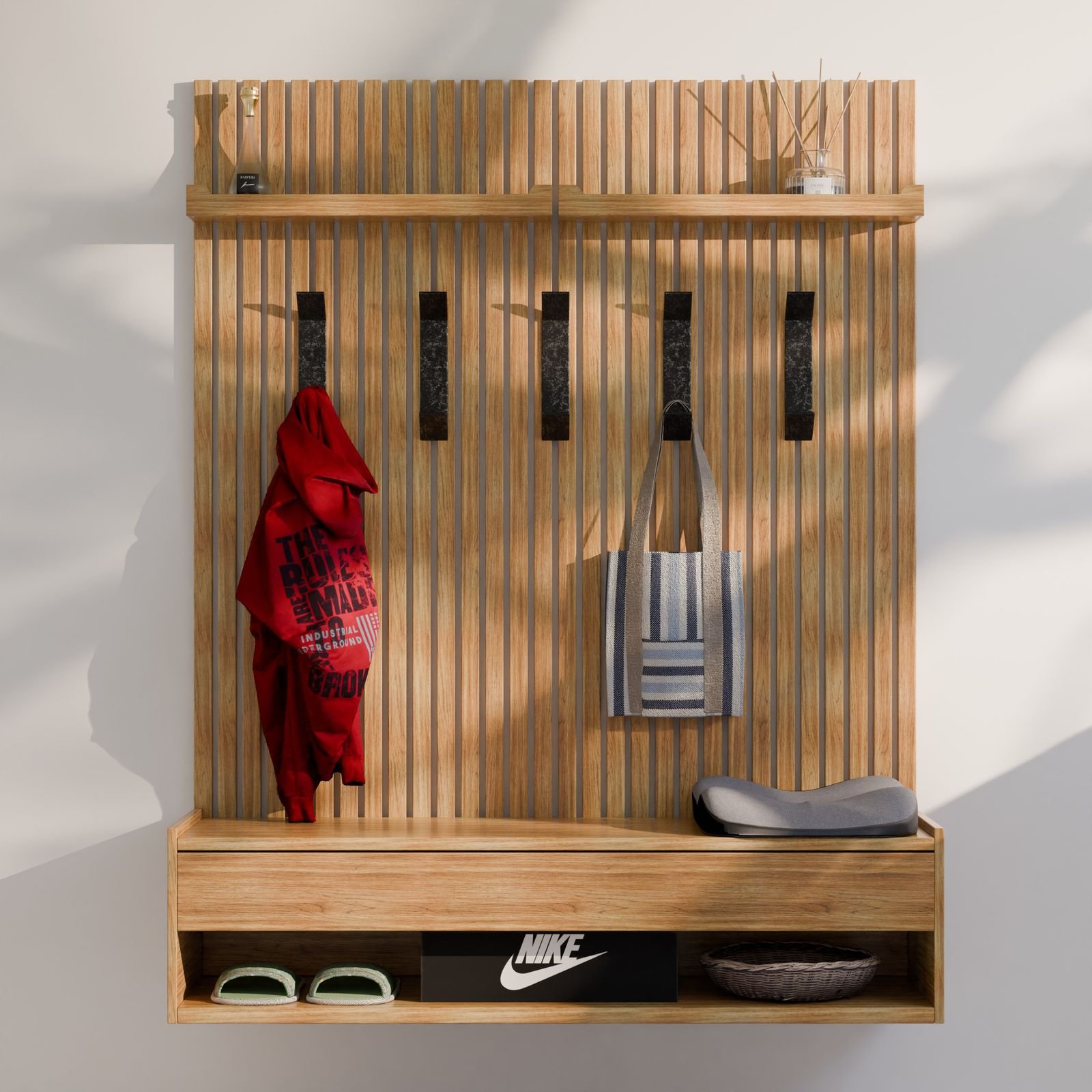

Every suburban house has a spot where the day falls apart: the back door, where coats land on chairs, shoes migrate across the floor, and school bags form a small mountain by Tuesday. A mudroom exists to catch all of that before it reaches the rest of the house. It does not need to be a separate room, and it does not need a renovation budget. What it needs is a place for every category of thing that comes through the door, a seat for putting shoes on, and a system simple enough that children and tired adults will actually use it.
Work out what really comes through your door
Before buying hooks or cubbies, spend a week noticing what actually lands by the back door. Count the coats, the pairs of shoes, the bags, the sports equipment and the dog leads. Most families overestimate coat storage and underestimate shoe storage. A family of four typically needs seating for one person at a time, hooks for four to six coats, and shoe storage for eight to twelve pairs in daily rotation, with out-of-season shoes stored elsewhere.
This count decides your layout. If you have a wide wall, a bench with cubbies above and below it is the classic solution. If you have a narrow hallway, a row of sturdy hooks, a slim bench and a boot tray may be all the space allows — and that is enough, provided every item has a named home.
The bench is the heart of the mudroom
A bench changes behaviour more than any other single item. Standing to take boots off means boots stay on; sitting down means they come off. The ideal bench height is around 45 centimetres, roughly dining-chair height, with a depth of about 40 centimetres so it does not jut into the walkway. If you are building in, add a shoe shelf or open cubbies beneath the bench so shoes slide out of sight instead of lining up along the wall.
Put a washable cushion on the bench — mudrooms get sat on in wet coats, so choose a cover you can remove and wash.
Hooks, cubbies and baskets: give everything a home
One hook per person is never enough, because one person owns a coat, a bag and possibly a sports jacket. Plan two hooks per person where space allows, using double hooks so a bag can hang behind a coat. Fit hooks at two heights if you have children: lower hooks at around 120 centimetres for younger children, standard hooks at around 170 centimetres for adults. Children use hooks they can reach; hooks they cannot reach are decoration.
Cubbies above the bench hold bags, lunchboxes and the things that otherwise end up on the kitchen counter. Baskets handle the loose items: one for hats and gloves, one for dog leads and treats, one for sunscreen and bug spray in summer. When winter arrives, swap the summer basket for one holding gloves, scarves and hand warmers, which connects neatly with the seasonal gear advice in our Energy-Saving Winter Decor guide.
Flooring and walls that can take a beating
A mudroom floor should be the easiest floor in the house to clean. If you are renovating, porcelain tile, luxury vinyl plank or sealed concrete all handle wet boots and muddy paws. If you are not, a large boot tray with raised edges, plus a washable rug runner, protects the existing floor for very little money. Choose a dark or patterned rug — a pale rug in a mudroom is a short-lived experiment.
Walls take abuse too, especially at shoe and bag height. A wipeable paint finish, or beadboard panelling up to about 120 centimetres, lets you wipe off mud splashes instead of repainting. Beadboard also suits the farmhouse and traditional styling common in suburban homes, and it pairs naturally with the practical storage approach in our US Farmhouse Kitchen Storage Ideas.
Small mudrooms and no mudroom at all
Not every suburban house has a spare room by the back door, and many have only a hallway or a corner of the laundry room. The principles do not change, only the scale. In a hallway, a wall-mounted bench that folds down, a row of hooks and a single boot tray can create a functioning drop zone in under a metre of wall. In a laundry room, keep the mudroom zone by the door and the laundry zone by the machines, with a clear line between them, or clean clothes will end up wearing the mudroom’s mud.
If your back door opens straight into the kitchen, a tall, narrow hall tree — a bench, hooks and a top shelf in one unit — placed beside the door gives you the same function without building anything. Anchor it to the wall, especially if children will climb on it, which they will.
Keeping it tidy after week one
The reason most mudrooms fail is not design but drift: out-of-season items creep in, broken umbrellas stay, and one person’s overflow becomes everyone’s problem. A five-minute reset each Sunday evening keeps it working — return out-of-season gear to its proper storage, empty the baskets of anything that does not belong, and wipe the bench. Twice a year, at the change of seasons, do a bigger sort: donate coats nobody wore last winter, replace broken hooks, and check that the boot tray still drains and dries properly.
Making it look like part of the house
A mudroom works best when it does not look like a utility cupboard. Paint it the same colour as the adjoining room, or a slightly deeper shade of it, so it feels intentional. Use the same style of hooks and baskets throughout rather than a mix of freebies. Add one personal touch — a framed family photo, a small plant on a high shelf out of coat range, or a favourite colour on the bench cushion — and the space stops feeling like a chore station and starts feeling like home.
Frequently asked questions
How much space do you need for a mudroom?
A functional mudroom can fit in about one metre of wall width with a bench, hooks and a boot tray. A full built-in bench with cubbies needs roughly 1.5 to 2.5 metres of wall. A separate room is a luxury, not a requirement.
What is the best bench height for a mudroom?
Around 45 centimetres, about dining-chair height, works for most adults and older children. Add a lower step or a small stool if younger children need help reaching their hooks.
How do I stop shoes piling up by the back door?
Give shoes a home that is easier than the floor: open cubbies or a shelf under the bench, plus a boot tray for wet pairs. Limit daily shoes to one or two pairs per person and store the rest elsewhere.
What flooring is best for a mudroom?
Porcelain tile, luxury vinyl plank and sealed concrete all handle mud and water well. On a budget, a boot tray and a washable runner over the existing floor protect it effectively.
Paste your AdSense code in Ad Inserter Block 3