

A hotel ruined regular towels for me.
Which hotel? Doesn’t matter. Cheap-ish. Forgettable. Except one thing. One glorious thing.
Pillows with zero give. Ice machine humming down the hall all night — all night! — and carpet that had clearly seen better decades. Me? I slept badly. Obviously.
Then morning. Bathroom. Towel rail, heated. I stepped out of the shower, grabbed that warm towel, wrapped up, and froze. Not from cold. From delight. Standing there like a statue. A very happy, very damp statue.
A grown adult, folks. Over a towel. I know how that sounds. Embarrassing? A bit. Worth it? Completely.
Home again. Shower. Towel. Cold. Damp in the middle. Cold at the edges. Every time. And the smell — that faint, sneaky musty smell towels get when they never dry properly. You ignore it. We all ignore it. Until a guest walks into your bathroom. Then suddenly you smell it. For them. Through their nose, somehow. Awful.
So I ordered one. That same week. No research spiral, no six-month debate. Just ordered. Delivery day: box like a surfboard. I actually laughed. Brother-in-law came round Saturday, drill in hand, opinions at the ready.
Since then? Warm towels. Every morning. Without fail. Honestly, best money this house has ever seen from me. Full stop, end of story.
Had you never considered one? Same. I hadn’t either. It sounded fancy. Hotel fancy. People-with-spare-bathrooms fancy. Turns out? Plug-in models cost less than dinner out with friends. Less! Install takes a weekend. A single weekend. And the payoff lands daily. Daily! Kind of ridiculous, in a good way.
Alright — everything I wish I’d known beforehand. Mistakes included. Especially mistakes.
What This Thing Actually Is
First visit after the install, my mom pointed straight at it. “What’s that — a heater? For towels?” Yes, Mom. Literally that. A heater for towels. Nothing more mysterious.
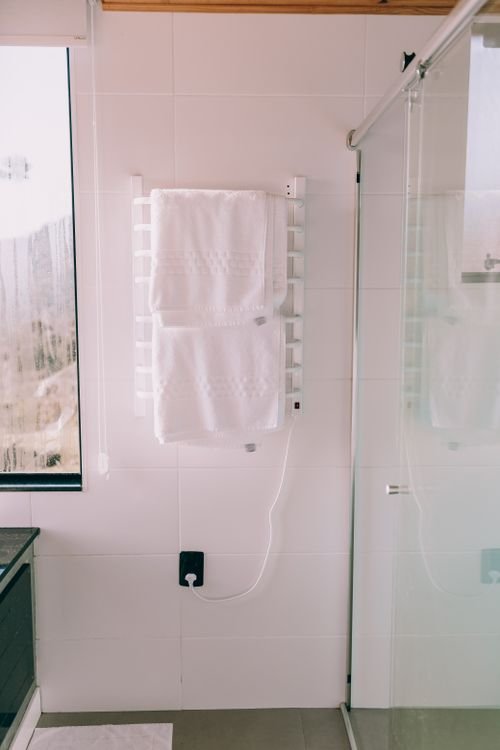
Picture a ladder. On your wall. With horizontal bars that get warm. Hang a towel over those bars after showering. Come back later: warm towel, dry towel. Not a sad damp towel. A proper towel. Concept over. That’s the whole concept.
Shopping, you’ll meet two main types. Plus a third type you’ll skim, nod at, and forget.
Electric warmers use an internal element. Think polite radiator, ladder-shaped. Plug-in ones go into a normal outlet. Hardwired ones connect straight into your house wiring. Different job entirely.
Hydronic ones? They tap into your hot-water heating system. Unless a plumber is already ripping your bathroom apart? Skip them. Seriously, skip. That’s gut-renovation territory, not weekend territory.
For a normal finished bathroom, electric wins. For normal people, electric wins. For me, electric won.
Mine is plug-in, ladder-style, roughly twenty inches across, eight bars, four brackets holding it to the wall. There’s a tiny switch on the side. Do I use it? Almost never. Because timer plug. Simple. It runs a few hours each morning, then switches off, and I forget the whole thing exists until tomorrow’s warm towel reminds me. Beautiful system. Zero effort system.
Complicated? Nope. It’s a warm ladder. And I adore it. Adore!
The Hotel Morning That Ruined Me
Why do I keep returning to that hotel morning? Because it changed my bathroom brain. Changed it completely. No exaggeration. Well, slight exaggeration. But close.
Sure, the warm towel grabbed the headlines. Obviously. But the feeling underneath? Bigger. That bathroom felt caring. Like it was looking after me. Weird sentence, true feeling.
Warm towel in hand, gentle warmth in the air, no horrible cold shock after showering. You know the shock — that shivery hopscotch on the bath mat, teeth almost chattering. We’ve all performed it. Every one of us. Admit it.
Unexpected part number one: towels don’t just warm up, they DRY. Really dry. Through and through. Every single time. Not warm-and-still-a-bit-wet. Dry.
Remember towels that feel dry on the outside but cool and clammy in the middle? That secret damp core? Yeah. That. Gone now. Vanished. My towels leave the rail fully dry. Fully! They stay fresh much longer between washes, too. Musty smell? History. Ancient history.
Unexpected part number two, and nobody puts this on a product page — probably because how do you even measure it? — the rail warms the room a little. Gently. Softly. Not heater-warm. Just less-cold warm.
My bathroom in winter used to be an icebox. Coldest room in the house, hands down. Tiles like ice. Vent pointing the wrong way. Six in the morning, shivering in a towel, regretting life choices. These days? Not toasty, I’ll be honest. Not a sauna. But neutral. Comfortable-neutral. Mornings stopped feeling like a race against the cold. Huge difference, honestly. Huge.
Can you price that feeling? Hard. I tried, though. Read on.
Plug-In or Hardwired: Be Honest With Yourself
Decision time. And — gentle warning — this decision reveals something about you. About how much faff you’ll tolerate. About cords. About electricians. No judgement from me. Just truth.
Plug-in equals easy. Mount, plug into a GFCI outlet, finished. My brother-in-law needed roughly forty minutes. Roughly! Twenty of those minutes were us debating height. Debating! He won. He always wins height debates. Infuriating man. Lovely man.
Hang a heavy mirror competently? Then plug-in installation is in your wheelhouse. Same anchors. Same wall skills. Same quiet fear that the stud finder is fibbing. (Mine fibs. Often. Measure twice, drill once, pray a little.)
Downside? One: the cord. Visible. Running down to the outlet, doing its cord thing. Fix? Cord cover, painted wall colour, twenty minutes, tidy result. My setup? Cord visible. Just hanging out. I stopped seeing it within a week. Guests? Never commented. Ever. Seriously, nobody inspects bathroom cords. Nobody. Relax about cords.
Hardwired equals clean. So clean. No cord, no plug, rail floating on the wall like it belongs there. Because it does. Gorgeous, I’ll grant that. Truly gorgeous.
Catch? Electrician required. Because house wiring. Because safety. Because no. This is not a watch-a-video-and-wing-it situation. Do not wing house wiring. Ever.
Already renovating, walls open, electrician on site anyway? Then hardwired, obviously. Add it to their list, job done. Finished bathroom, tiles intact, wire would mean cutting things open? Then plug-in suddenly looks brilliant. Brilliant and sensible.
So, my take, plain and simple: Renting, or impatient, or weekend-project person? Plug-in. Take it with you when you move, even. Portable cosiness! Full renovation with professionals already involved? Hardwired, enjoy that seamless look. You earned it.
No wrong choice here. Just different effort, different cord feelings. Cord feelings are valid feelings.
Does plug-in appeal? Then Weekend DIY Home Decor: 5 Projects Under $50 speaks your language. Small jobs, big wins, finished before dinner. A plug-in towel warmer belongs in that world completely.
Where to Put It (Location Matters More Than You Think)
I almost put mine in the wrong spot.
All planned. Wall across from the shower. Why? Most empty space. Empty space felt logical. For a new thing, right?
Brother-in-law took one look. “So you want to do the cold sprint every morning?” Hated that he was right. Again.
Ideal spot? Right next to the shower or tub. Close enough to reach the warm towel. No cold sprint.
Mine sits on the wall directly beside the shower door. Open door. Grab towel. Wrap up. Three seconds. Zero shivering. That’s the whole user experience. And it’s great.
What you don’t want: rack across the room from the shower. Then the warm towel has to travel. Ten-foot walk through cold air. Entire point? Defeated. By a walk.
Also avoid direct splash. Built for bathrooms, safe around humidity, sure. But don’t aim the showerhead at it. Beside the shower. Not inside the splash zone. Simple.
Surprise for people: small bathrooms are actually perfect for these. Sounds backwards. I know.
Compact bathroom? Rail’s gentle warmth has a proportionally bigger effect. Makes sense when you think about it. Smaller room, same warmth.
My neighbor’s bathroom is tiny. Five by seven feet. One of those bathrooms where you can touch both walls if you stretch. She put a narrow vertical-style warmer on the one free stretch of wall beside her shower.
Holds two towels. Sticks out maybe four inches. She says the room went from cold box to cozy overnight. Overnight! I believe her.
Narrow ladder styles exist now, specifically for tight spaces. Don’t assume your bathroom is too small. Measure first. Seriously.
Height-wise, center the rail so the middle bars land around chest height. Drape the towel over the top bars. Let it hang naturally.
Too high? Reaching every morning like you’re flagging down a bus. Too low? Towel puddles on the floor. Which defeats the entire purpose in the most literal way possible. Don’t do that.
Pairing this with other small-bathroom upgrades? Small Space, Big Style: Decor Trends for Compact Homes has ideas that go really well with this kind of upgrade.
Finishes: Chrome Isn’t Your Only Option
Shopping, I assumed chrome only. That shiny mirror finish on every hotel one.
Chrome is fine. Classic. Matches everything. Wipes clean. But it’s not the only option anymore. And finish honestly changes the whole feeling of the bathroom. Whole feeling.
Brushed nickel and stainless. The soft alternatives. Same silvery family. Muted instead of mirror-shiny.
Practical win: they don’t show water spots the way chrome does. Real daily-life consideration. Not a design footnote.
My chrome rail needs a wipe-down every week or it starts looking spotty. My friend’s brushed nickel one? Basically takes care of itself. Unfair, honestly.
Buying again tomorrow, I would think really hard about brushed nickel. Like, hard.
Matte black. The dramatic choice. Right bathroom? Gorgeous. Against white tile, a black ladder rail looks like a deliberate design statement. Against dark tile it disappears into this moody, cool thing.
Know going in, though: black shows dust and towel lint more than you’d ever guess. High-maintenance beauty. Worth it if you love the look and don’t mind wiping things down. Annoying if wiping things down isn’t your idea of fun. Fair enough.
Brass and gold tones. Having a whole moment in bathrooms right now. Brushed brass warmer in a bathroom with brass faucets? Guests go “oh, fancy” without knowing why. I love that detail.
Metallics are doing interesting things across interiors this year — Silver Is Back: The Cool Metallics Comeback in Home Decor for 2026 gets into the full story.
My rule is dead simple. Match the rail to your faucet finish. Easiest way to make the whole thing look intentional instead of added-on. Intentional. Not bolted-on-later. Big difference.
The Warm Minimalism Bathroom
Can I describe my dream bathroom? Please?
Heated towel rail as centerpiece. Warm white walls. Light oak vanity. Big soft towels in cream and oatmeal. Brushed nickel rail, two thick towels warming on it. One plant on the windowsill. Nothing else. That’s the whole room. That’s it.
I think about this bathroom more than is probably healthy. Probably unhealthy, actually. Whatever.
There’s a reason this look keeps showing up everywhere. Bathrooms went through a cold, clinical phase. Gray tile, chrome everything, harsh lighting. Looked like a laboratory where you happened to shower. Gross.
Shift toward warmth — bathrooms that feel like an exhale instead of a procedure — is one of the best things happening in interiors right now. An exhale. Yes.
I wrote about the bigger picture in Warm Minimalism: 2026’s Biggest Decor Shift, and the bathroom might be where that shift matters most. First room you see in the morning. Last one at night. It should be kind to you. Kind! What a concept.
Towel warmer fits this perfectly because it’s functional warmth, not just visual warmth. Not a warm paint color pretending to be cozy. An actual warm object. You touch it and it’s warm. That does something to a room that paint can’t do. Paint can’t hug you back. This kind of can.
Slowly warming up a cold, clinical bathroom? Start here. Single object with the biggest coziness-per-dollar ratio I know. I’ve run the numbers in my head many times. It wins every time. Every time.
The Stuff Nobody Mentions
Unglamorous practical stuff. Things product pages skip because they aren’t sexy.
Towels last longer. Because they dry completely between uses, they never get that musty smell that used to send mine to the wash after three days. Three days! Now? I wash my bath towels about half as often as I used to. And they smell better than when I washed them twice as much. Explain that.
Fewer laundry loads. Quiet little win for the water bill and your weekend. Nobody buys a towel warmer for laundry savings. Nice surprise anyway. I’ll take it.
Don’t put delicates on it. Learned this the fun way — which is to say the stupid way. Draped a nice top over the rail to warm it up before going out. Forgot about it for two hours. Two hours. Heat pressed a weird little crease pattern from the bars right into the fabric. Bar lines. Across the front. I wore a different top. Obviously.
Towels and bathrobes only. The rail is for towels. Respect the rail.
Timer is non-negotiable. Mine runs on a simple plug-in timer, three hours every morning. Without it I’d either forget to turn it on and get a cold towel, or forget to turn it off and run it all day like a maniac. Maniac energy. No thanks.
Timer means I never think about it. Wake up, shower, warm towel. Just how mornings work now.
Fancier models have built-in timers, which is nice. But a ten-dollar plug timer does the exact same job. Don’t overthink the timer.
It won’t heat your bathroom like a radiator. Let’s be real. Towel warmer, not a space heater. Takes the edge off. Makes the room feel less cold. But if your bathroom is genuinely freezing, you still need actual heating.
Think of the room-warming as a bonus, not the feature. Feature is the towel. Warm room is the cherry on top. Cherry. On top. Got it?
What It Actually Costs
Let’s talk money, because “affordable luxury” means absolutely nothing without numbers. Nothing. Zero. Give me numbers or stop.
My plug-in rail cost $189. About two years ago. Mid-range brand, eight bars, chrome.
Seen decent ones for less. Fancy hardwired ones for a lot more. Sweet spot for a good plug-in? Right in that range.
Not cheap-cheap. But firmly in nice-dinner-out territory, not reno-budget territory. I’ve spent more on throw pillows. A little ashamed of how true that is. A little.
Running costs? My electricity bill barely moved. I mean it. Braced for a jump. Wasn’t one I could detect. At all.
Rail draws about as much as a couple of light bulbs, and it only runs three hours a day on the timer. Leave bathroom lights on all day? Rail is the least of your worries. Least.
I’m not going to quote exact figures — every unit and every electricity rate is different — but in the category of household appliances, this thing is a featherweight. Featherweight. Tiny.
Installation cost me a pizza. Brother-in-law wouldn’t take money, so I bought dinner. Fair trade? Best trade, honestly.
Hire a handyman for a plug-in install? Small job. An hour, tops. Hardwired needs an electrician — that’s a real service call, factor that in. Real money.
But the unit itself, the thing that gives you warm towels every morning for years? Under two hundred bucks. Under. Two hundred.
I think about that every morning while wrapped in a warm towel. Best trade I have ever made. Every morning. Still.
Stuff People Ask Me
Okay so my DMs are basically the same five questions on repeat. Towel-warmer edition. Let me just answer them here. Same five. Every time.
“Can I install it myself?” — brother-in-law did mine, and he is handy but not a professional. Not even close. Guy with a drill and strong opinions. That’s the résumé. How it went: held the rail against the wall, marked the four bracket holes with a pencil, drilled, put in wall anchors for the drywall, screwed in the brackets, hung the rail, plugged it in. Forty minutes. Including twenty minutes arguing about whether it was level. It was level. He was right. Again. Of course. Plug-in ones are genuinely a DIY job if you’re comfortable with a drill and a level. Hardwired ones aren’t. Electrician territory, full stop. Don’t mess with house wiring because a blog post told you it was easy. My rule: if it plugs into an outlet, you can probably do it. If it needs to be wired into the wall, call someone who does that for a living. And measure the height before you drill, not after. We got lucky. You might not. Measure first. Please.
“Does it actually dry towels, or just warm them?” — both, and the drying is the part that surprised me most. Winter test: I used to hang my towel on a regular hook in winter, and by morning it would still be faintly damp in the middle. That cool, slightly clammy feeling that makes you do the ugh face. You know the face. With the rail, I drape the towel over the bars after my evening shower, timer runs a few hours, and by morning it’s completely dry. Bone dry. Warm if the timer’s still running, room temperature if it’s not — but dry either way. Heat drives the moisture out steadily instead of letting it sit there all night getting funky. My towels have never smelled musty since I got the rail, and my bathroom has no window, so that’s basically a miracle. Yes, it dries. Properly. That alone would be worth it even if the warm-towel thing didn’t exist. Alone. Worth it.
“Does it use a lot of electricity?” — I worried about this too, because the word “heated” sounds expensive. Sounds expensive. Isn’t. Here’s what actually happened: my electricity bill after installing it looked exactly like my bill before installing it. I compared three months before and three months after — because I’m that person — and I couldn’t find the difference. Rail runs on a timer for three hours every morning. That’s it. Not running all day. Not heating a room. Warming eight metal bars for a few hours. That’s the job. Neighbor asked me the same question when she was considering one, and I told her straight: if you can afford to run your bathroom light, you can afford to run the rail. She got one last month and texted me last week to say her bill didn’t move either. Texted me! Same result. Get the timer. That’s the whole secret. Three hours a day, warm towels, invisible bill.
“Will it fit in a tiny bathroom?” — my neighbor’s bathroom is the answer. Maybe five by seven feet, one of those bathrooms where you can touch both walls if you stretch your arms out. She was convinced there was no room. None. Zero. Then she found a narrow vertical-style warmer — about sixteen inches wide — and put it on the only free stretch of wall beside the shower. Holds two towels folded over the bars. Sticks out maybe four inches from the wall. She says it transformed the room, because in a tiny bathroom the gentle warmth is proportionally a bigger deal. Went from cold and cramped to cozy and intentional. Her words, not mine. Cozy and intentional. Perfect description. So measure your wall space before you assume it won’t fit. They make these in genuinely narrow sizes now, and a small rail in a small bathroom punches way above its size. Only real requirement: a nearby outlet for the plug-in kind, or an electrician for the hardwired kind. That’s it.
“Is it safe? I have kids.” — fair question, and I asked it too, because my niece visits and she touches everything. Everything. She’s five and has no concept of “don’t touch that.” None. Short answer: rail gets warm, not hot. You can put your hand flat on a bar and hold it there. Towel-warm, not burn-yourself warm. Big difference. It’s designed to sit in a bathroom with wet people and bare feet, so the safety standards are serious. Serious. That said, it’s still a warm electrical thing on the wall, so use common sense. Mount it high enough that small kids aren’t using it as a climbing frame. Keep the cord tidy and out of reach for toddlers. Don’t drape anything flammable over it for hours. My niece has been around mine for two years. She knows it’s the “warm towel thing” and she loves it. I mounted it at adult chest height, cord runs behind it to the outlet, and it’s been a complete non-issue. Safer than the curling iron I used to leave on the counter, that’s for sure. Way safer.
So that’s the heated towel rack. The hotel luxury that turned out to be a two-hundred-dollar plug-in ladder. Two hundred dollars. Plug-in ladder. Hotel luxury at home.
If you’re on the fence, here’s my pitch. You use a towel every single day. Every day. One of the most-used objects in your entire house. Most-used!
Making that one daily moment warm and dry instead of cold and damp is the highest-frequency upgrade I know. Highest-frequency. Daily. Every day.
Two years in, I still notice it. Every morning. Still a happy idiot with a warm towel. Go get the warm ladder.
Paste your AdSense code in Ad Inserter Block 3